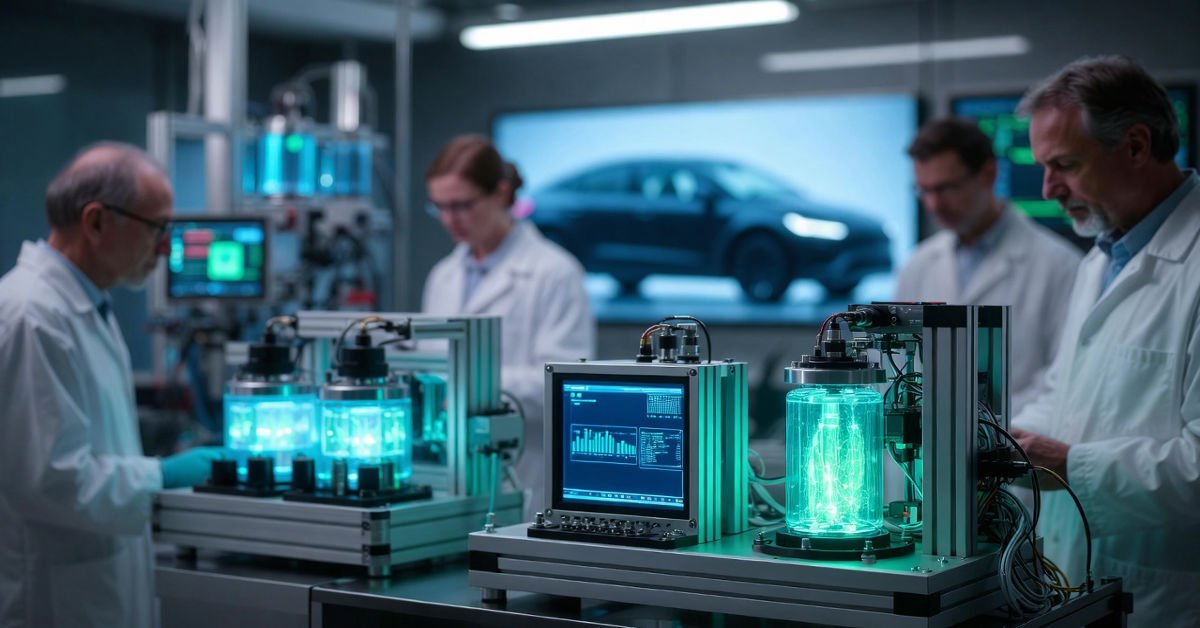
The United States is at the forefront of next-generation energy storage innovation, and solid-state batteries have become one of the most promising technologies in this transformation. With electric vehicles (EVs), renewable energy storage, and defense applications demanding safer and more efficient batteries, American laboratories, universities, and private companies are intensifying their performance testing of solid-state battery systems.
Solid-state battery performance tests in the USA focus on improving energy density, safety, charging speed, lifespan, and scalability. These tests are not limited to laboratory theory; they increasingly involve real-world simulations that mirror how batteries behave inside electric vehicles, grid storage systems, and consumer electronics.
This article explores how solid-state batteries are tested in the United States, what results have been achieved so far, the role of government and private industry, and what these findings mean for the future of clean energy.
Understanding Solid-State Batteries
Solid-state batteries differ from conventional lithium-ion batteries by replacing liquid electrolytes with solid materials. This change significantly reduces the risk of leakage, fire, and chemical degradation.
Unlike traditional batteries, which use flammable liquid electrolytes, solid-state batteries rely on ceramic, polymer, or sulfide-based solid electrolytes. These materials allow lithium ions to move safely between the anode and cathode while providing better thermal stability.
The goal of solid-state battery performance testing in the USA is to validate whether these theoretical advantages can hold up under demanding real-world conditions such as high temperatures, repeated fast charging, and long operational cycles.
Why Performance Testing Matters in the USA
The United States has invested billions of dollars into battery research through agencies like the Department of Energy (DOE), National Laboratories, and university research centers. Performance testing ensures that solid-state batteries are:
-
Safe for public use
-
Reliable over long periods
-
Cost-effective to manufacture
-
Capable of powering large systems such as EV fleets
Testing is critical because small material defects or design flaws can lead to rapid degradation or safety hazards. American testing standards aim to simulate years of battery usage within a short time frame.
Key Performance Metrics Used in US Testing Programs
Solid-state battery performance tests in the USA measure multiple factors simultaneously. These metrics are standardized across research institutions to allow consistent comparisons.
Core Performance Metrics in Solid-State Battery Testing
| Performance Metric | Description | Importance |
|---|---|---|
| Energy Density | Amount of energy stored per unit weight or volume | Determines driving range and device runtime |
| Cycle Life | Number of charge-discharge cycles before degradation | Indicates battery longevity |
| Charging Speed | Time required to reach full charge | Essential for EV adoption |
| Thermal Stability | Resistance to overheating | Critical for safety |
| Mechanical Durability | Resistance to cracking or deformation | Impacts reliability |
| Operating Temperature Range | Performance under extreme cold or heat | Important for US climate diversity |
These metrics help engineers identify weaknesses in materials and design before commercial deployment.
Testing Environments Used in the United States
American research facilities use a variety of controlled environments to simulate real-world battery conditions. These include:
-
Climate chambers to test performance in extreme temperatures
-
Vibration rigs to simulate vehicle movement
-
High-current systems for fast-charging trials
-
Long-term cycling stations for durability analysis
Institutions such as Argonne National Laboratory, Oak Ridge National Laboratory, and Sandia National Laboratories conduct independent verification tests on solid-state battery prototypes from both public and private partners.
Government Role in Solid-State Battery Testing
The US Department of Energy (DOE) plays a central role in coordinating solid-state battery research and testing. Programs like the Battery500 Consortium and ARPA-E initiatives fund performance trials aimed at achieving energy densities above 500 Wh/kg.
DOE-supported testing focuses on:
-
Safety validation
-
Material compatibility
-
Manufacturing feasibility
-
Environmental impact
These federally funded tests ensure that innovations meet strict regulatory and safety standards before entering the market.
Major US Institutions Conducting Solid-State Battery Performance Tests
| Institution | Focus Area | Contribution |
|---|---|---|
| Argonne National Laboratory | Electrolyte chemistry | Materials testing and modeling |
| Oak Ridge National Laboratory | Manufacturing processes | Scale-up testing |
| Sandia National Laboratories | Safety and stress testing | Failure analysis |
| MIT Energy Initiative | Battery design | Prototype evaluation |
| Stanford University | Solid electrolyte research | Long-term cycling studies |
These institutions collaborate with automakers and battery manufacturers to bridge the gap between laboratory success and commercial readiness.
Private Sector Performance Testing in the USA
American companies have accelerated solid-state battery testing in partnership with research institutions. Their focus is on commercial readiness rather than only academic performance.
Key private-sector testing areas include:
-
High-speed charging capability
-
Structural stability under vibration
-
Mass production consistency
-
Integration into EV battery packs
Many US startups use pilot production lines to test thousands of cells simultaneously, identifying manufacturing defects early in development.
Real-World Simulation Tests
Solid-state battery performance tests in the USA increasingly include real-world simulations. These tests replicate:
-
Daily EV charging routines
-
Urban stop-and-go driving
-
Highway range conditions
-
Grid storage discharge patterns
Simulation tests help engineers understand how batteries degrade under actual usage patterns instead of ideal laboratory conditions.
Lab Tests vs Real-World Simulation Tests
| Testing Type | Purpose | Outcome |
|---|---|---|
| Laboratory Cell Tests | Measure chemical performance | Data on efficiency and capacity |
| Thermal Stress Tests | Examine heat tolerance | Safety validation |
| Vehicle Simulation | Test under driving conditions | Practical reliability |
| Grid Storage Simulation | Evaluate long-duration discharge | Infrastructure suitability |
Combining both testing approaches ensures that performance claims are grounded in reality.
Safety Testing and Regulatory Compliance
Safety is a top priority in US battery testing. Solid-state batteries must pass strict federal guidelines before commercial approval.
Testing includes:
-
Overcharging and short-circuit tests
-
Puncture and crush resistance tests
-
Fire resistance evaluation
-
Long-term storage stability
Compared to lithium-ion batteries, solid-state batteries consistently show improved resistance to thermal runaway during these tests.
Challenges Identified Through Performance Testing
Despite promising results, US testing programs have revealed several challenges:
-
Cracking in solid electrolytes over time
-
High production costs
-
Difficulty maintaining stable contact between layers
-
Limited performance at extremely low temperatures
These challenges guide future research and material innovation.
Key Challenges and Solutions Identified in US Testing
| Challenge | Cause | Current Research Direction |
|---|---|---|
| Electrolyte cracking | Mechanical stress | Flexible polymer electrolytes |
| High cost | Complex materials | Scalable manufacturing |
| Interface resistance | Poor layer bonding | Advanced coatings |
| Cold weather performance | Ion mobility issues | Hybrid electrolyte systems |
Environmental and Sustainability Testing
Performance testing in the USA also includes environmental impact assessments. Solid-state batteries are evaluated for:
-
Material recyclability
-
Carbon footprint during manufacturing
-
Chemical toxicity
-
Long-term waste management
These tests support federal clean energy goals and help ensure compliance with environmental standards.
Expert Insights and Industry Experience
Battery engineers involved in US testing programs report that solid-state batteries consistently outperform lithium-ion batteries in controlled safety tests. However, they emphasize that mass production and affordability remain the largest barriers.
Experts also note that long-term cycle testing is essential, as early performance success does not always translate into multi-year reliability.
Future Outlook for Solid-State Battery Testing in the USA
Over the next decade, the United States is expected to expand solid-state battery performance testing from prototype cells to full vehicle battery packs.
Future testing goals include:
-
Achieving 1,000+ charge cycles without degradation
-
Reducing charging time below 10 minutes
-
Improving cold-weather performance
-
Lowering manufacturing costs
Large-scale pilot plants are already being developed to support these objectives.
Economic Impact of Solid-State Battery Testing
Solid-state battery performance tests drive economic growth by:
-
Creating research jobs
-
Supporting domestic battery manufacturing
-
Strengthening energy independence
-
Encouraging private investment
Testing programs also help the USA compete globally in battery innovation.
Economic Benefits of Solid-State Battery Development
| Benefit | Impact |
|---|---|
| Job creation | Skilled engineering and lab roles |
| Energy security | Reduced dependence on imports |
| Technology leadership | Global competitiveness |
| Infrastructure development | New manufacturing facilities |
Conclusion
Solid-state battery performance tests in the USA represent a crucial step toward safer, more efficient, and longer-lasting energy storage systems. Through collaboration between government agencies, universities, and private companies, the United States is establishing itself as a leader in next-generation battery validation.
While challenges remain in scalability and cost, ongoing testing continues to improve material performance, safety, and real-world usability. These efforts bring the nation closer to a future where electric vehicles charge faster, renewable energy storage lasts longer, and battery-related safety risks are dramatically reduced.
3 thoughts on “Solid-State Battery Performance Tests in the USA”