Introduction
Wireless EV Charging Technology in the USA are transforming the transportation landscape in the United States. As more drivers switch from petrol and diesel vehicles to electric alternatives, charging infrastructure has become one of the most critical factors influencing EV adoption. While traditional plug-in charging is widely used today, it still presents challenges such as cable handling, wear and tear, and inconvenience in public and residential settings.
This is where wireless EV charging technology comes into focus. Often referred to as inductive charging, this innovative system allows electric vehicles to charge without physical cables. In the USA, wireless EV charging is no longer a concept limited to laboratories—it is actively being tested, deployed, and improved for real-world use.
This article provides a comprehensive, experience-driven, and expert overview of wireless EV charging technology in the USA, including how it works, current developments, benefits, limitations, safety standards, and future potential.
What Is Wireless EV Charging?
Wireless EV charging is a method of transferring electrical energy from a charging source to an electric vehicle without direct physical contact. Instead of plugging in a cable, the vehicle is parked over a charging pad installed on the ground. Power is transferred wirelessly using electromagnetic fields.
This technology is based on electromagnetic induction, the same principle used in wireless smartphone chargers, but on a much larger and more powerful scale suitable for vehicles.
How Wireless EV Charging Technology Works
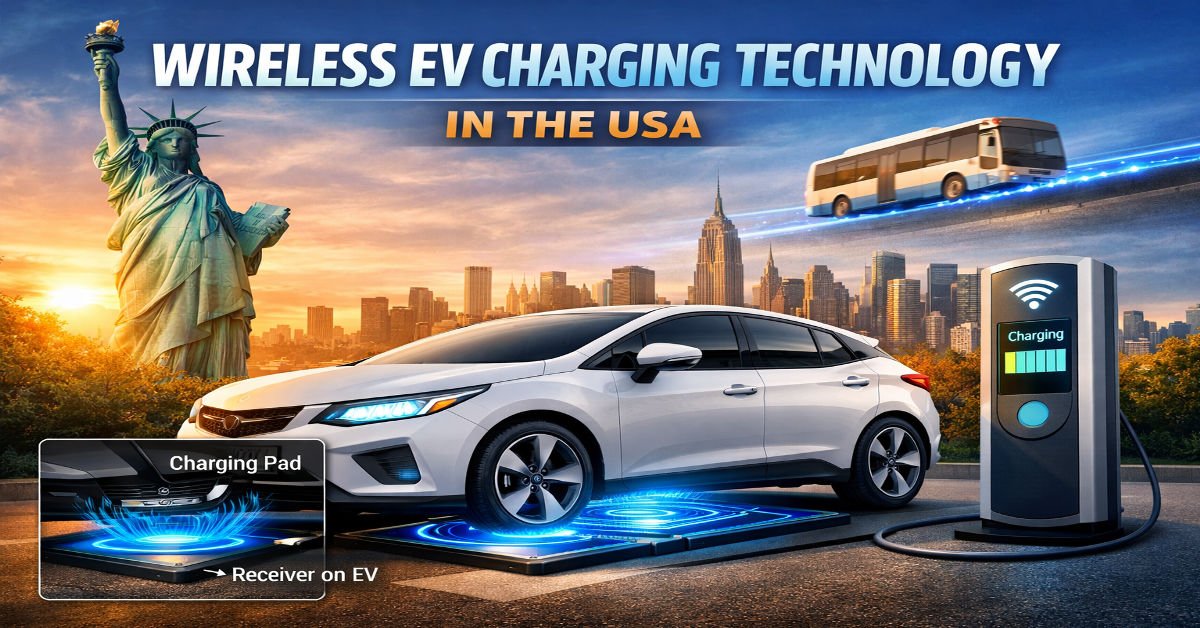
Wireless EV charging systems consist of two main components:
-
Ground Assembly (Transmitter Pad) – Installed on the road surface or garage floor
-
Vehicle Assembly (Receiver Pad) – Mounted underneath the EV
When the vehicle is positioned correctly, electricity flows from the transmitter pad to the receiver pad using magnetic fields. The received power is then converted into usable electricity to charge the vehicle’s battery.
Step-by-Step Charging Process
| Step | Description |
|---|---|
| Vehicle positioning | The EV parks above the ground charging pad |
| Alignment detection | Sensors ensure proper alignment |
| Power transmission | Magnetic field transfers energy wirelessly |
| Energy conversion | Receiver converts energy to electrical power |
| Battery charging | Power is stored in the EV battery |
Paragraph explanation:
This automated process eliminates the need for manual plugging, making charging simpler and more accessible, especially for elderly users, people with disabilities, and fleet vehicles that require frequent charging.
Types of Wireless EV Charging Systems in the USA
Wireless EV charging is being developed in different formats depending on usage needs and infrastructure availability.
1. Static Wireless Charging
Static charging occurs when the vehicle is stationary, such as in a garage, parking lot, or curbside space.
| Feature | Static Wireless Charging |
|---|---|
| Vehicle movement | Stationary |
| Installation | Homes, offices, public parking |
| Power levels | Medium to high |
| Commercial readiness | Available for pilot use |
Paragraph explanation:
Static wireless charging is currently the most mature form in the USA and is being tested by automakers and municipalities for residential and commercial applications.
2. Dynamic Wireless Charging
Dynamic charging allows EVs to charge while driving, using charging coils embedded beneath the road surface.
| Feature | Dynamic Wireless Charging |
|---|---|
| Vehicle movement | In motion |
| Installation | Highways, bus routes |
| Power delivery | Continuous |
| Current status | Pilot and research stage |
Paragraph explanation:
In the USA, dynamic charging projects are mainly focused on public transport, logistics routes, and smart highways, as they can significantly reduce range anxiety.
Key Wireless EV Charging Standards in the USA
Standardization is crucial for safety, compatibility, and large-scale adoption.
| Standard | Organization | Purpose |
|---|---|---|
| SAE J2954 | Society of Automotive Engineers | Wireless EV charging interoperability |
| FCC regulations | Federal Communications Commission | Electromagnetic safety |
| UL certifications | Underwriters Laboratories | Equipment safety |
Paragraph explanation:
The SAE J2954 standard plays a vital role in ensuring that wireless chargers work across different vehicle brands, which increases consumer confidence and industry adoption.
Advantages of Wireless EV Charging Technology
Wireless charging offers several practical and long-term benefits for EV users and infrastructure developers.
Convenience and Ease of Use
| Benefit | Explanation |
|---|---|
| No cables | Eliminates plugging and unplugging |
| Weather resistance | Safer during rain or snow |
| User friendly | Ideal for daily charging |
Paragraph explanation:
This level of convenience significantly improves the EV ownership experience, especially in urban environments and shared parking spaces.
Improved Safety
Wireless charging systems reduce risks associated with exposed cables.
| Safety Aspect | Advantage |
|---|---|
| Electrical hazards | Reduced risk of shock |
| Mechanical wear | No cable damage |
| Accessibility | Suitable for all users |
Paragraph explanation:
Because there is no physical connection, wireless systems are safer in public areas and can lower maintenance costs.
Support for Autonomous Vehicles
| Feature | Importance |
|---|---|
| Automatic charging | No human involvement |
| Fleet efficiency | Ideal for robotaxis |
| Smart integration | Works with AI parking |
Paragraph explanation:
Wireless charging is essential for the future of self-driving EVs, where human intervention will be minimal or unnecessary.
Challenges and Limitations in the USA
Despite its advantages, wireless EV charging still faces several challenges.
Efficiency Loss
| Aspect | Wired Charging | Wireless Charging |
|---|---|---|
| Energy efficiency | Higher | Slightly lower |
| Power transfer | Direct | Inductive |
Paragraph explanation:
Although efficiency is improving, wireless systems currently lose a small percentage of energy compared to wired charging.
Higher Installation Costs
| Cost Factor | Impact |
|---|---|
| Ground installation | Expensive |
| Vehicle retrofitting | Additional cost |
| Infrastructure upgrades | Required |
Paragraph explanation:
These costs can slow adoption, especially for individual homeowners and small businesses.
Wireless EV Charging Projects in the USA
Several pilot programs and demonstrations are shaping the future of this technology.
| Project Type | Location | Application |
|---|---|---|
| Public road trials | Michigan | Dynamic charging |
| Transit buses | California | Fleet charging |
| Residential pilots | Utah | Home use |
Paragraph explanation:
These projects provide valuable real-world data and help policymakers understand how wireless charging can fit into national EV strategies.
Environmental Impact and Sustainability
Wireless EV charging supports environmental goals by encouraging wider EV adoption.
| Environmental Benefit | Impact |
|---|---|
| Reduced emissions | More EV usage |
| Smart energy use | Grid optimization |
| Urban planning | Cleaner cities |
Paragraph explanation:
When combined with renewable energy sources, wireless charging can further reduce the carbon footprint of transportation in the USA.
Future of Wireless EV Charging in the USA
The future looks promising as technology advances and costs decrease.
Expected Developments
| Trend | Description |
|---|---|
| Higher efficiency | Improved coil designs |
| Wider standard adoption | More vehicle compatibility |
| Smart city integration | Embedded road systems |
Paragraph explanation:
Experts believe that wireless EV charging will become common in new buildings, parking facilities, and selected roadways within the next decade.
Is Wireless EV Charging Safe?
Wireless EV charging systems in the USA must comply with strict safety regulations.
| Safety Factor | Status |
|---|---|
| EMF exposure | Within legal limits |
| Fire risk | Extremely low |
| User safety | Fully regulated |
Paragraph explanation:
Independent testing and government oversight ensure that wireless EV charging is safe for humans, animals, and electronic devices.
Consumer Adoption Outlook
| User Group | Adoption Potential |
|---|---|
| Urban EV owners | High |
| Fleet operators | Very high |
| Rural users | Moderate |
Paragraph explanation:
As awareness increases and infrastructure expands, consumer confidence in wireless EV charging will continue to grow.
Conclusion
Wireless EV charging technology represents a significant step forward in the evolution of electric mobility in the USA. By eliminating cables, improving convenience, and supporting future autonomous and smart transportation systems, this innovation has the potential to reshape how Americans charge their vehicles.
Although challenges such as cost and efficiency remain, ongoing research, pilot programs, and standardization efforts are steadily addressing these concerns. With continued investment and policy support, wireless EV charging could soon become a mainstream feature of the American EV ecosystem.
1 thought on “Wireless EV Charging Technology in the USA”