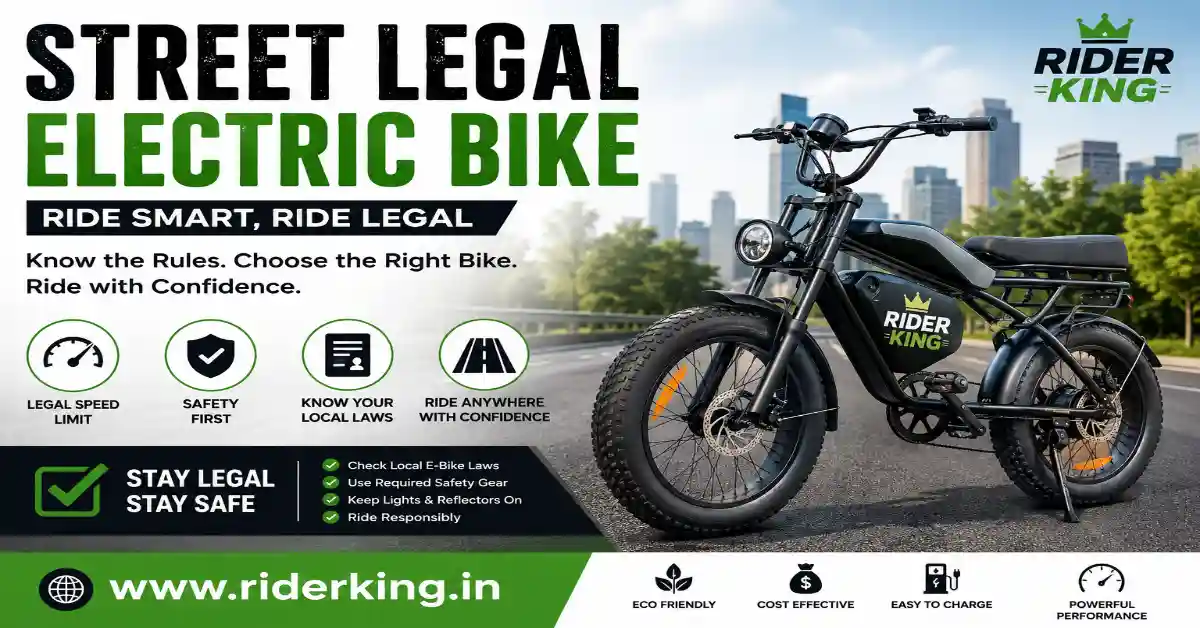
Street Legal Electric Bike can look almost identical to a regular bicycle, but its motor power, maximum assisted speed, equipment, and the laws where you live can determine where and how you are allowed to ride it.
I’ve found that this is one of those areas where spending an extra few minutes checking the rules can save you a lot of frustration later. A bike that is perfectly legal in one location may have different requirements somewhere else.
So, if you’re shopping for a Street Legal Electric Bike here’s what I would check before spending money.
What Does Street Legal Electric Bike Actually Mean?
A street legal electric bike is generally an e-bike that meets the requirements established by the local laws for riding on public roads.
The important part is that there isn’t one universal definition that applies everywhere.
Different countries, states, provinces, and cities can have their own rules concerning:
- Maximum assisted speed
- Motor power
- Throttle operation
- Pedal assistance
- Minimum rider age
- Helmet requirements
- Lights and reflectors
- Registration
- Licensing
- Insurance
- Where electric bikes can be ridden
This is why I wouldn’t buy an electric bike simply because a seller describes it as “street legal.”
That phrase is useful for marketing, but your local regulations are what actually matter.
Why Legal Classification Matters
Imagine finding an electric bike with a powerful motor and a high top speed. On paper, it may look like an amazing commuter.
Then you discover that your local regulations classify it differently from an ordinary pedal-assisted e-bike.
That can change where you’re allowed to ride it and whether additional requirements apply.
This is one of the mistakes buyers commonly make: they look at the motor and battery first and the legal classification last.
I’d reverse that process.
Check the rules first, then choose the bike.
What Should You Check Before Buying?
Before ordering an electric bike, I recommend creating a small checklist.
You don’t need anything complicated. You just need to verify a few specifications.
| What to Check | Why It Matters |
|---|---|
| Motor power | Local regulations may establish limits |
| Maximum assisted speed | Determines how the bike may be classified |
| Throttle | Some locations treat throttle-equipped bikes differently |
| Pedal assistance | May affect legal classification |
| Brakes | Required equipment in many jurisdictions |
| Headlight and taillight | Important for visibility and legal compliance |
| Reflectors | May be required for road use |
| Horn or bell | Requirements vary |
| Rider age | Some jurisdictions have minimum ages |
| Helmet | Requirements vary by location |
| Registration | May apply to certain categories |
| Insurance | May be required in some circumstances |
Don’t rely entirely on the product title.
Look at the actual technical specifications.
Find Your Local E-Bike Rules
This is the step I’d do before even comparing brands.
Search your local government transportation or road authority website for electric bicycle regulations.
For example, if you’re in the United States, don’t assume that a rule you found for another state automatically applies to you.
Look specifically for information about:
Electric bicycles
E-bike classifications
Motor power
Maximum speed
Throttle requirements
Helmet requirements
Bike-path restrictions
Road-use requirements
Government sources are much more useful for this than random product listings or social media comments.
Check the Bike’s Motor and Speed
Motor specifications can be confusing because manufacturers don’t always present them in exactly the same way.
You’ll commonly see terms such as:
- Nominal motor power
- Peak motor power
- Maximum assisted speed
- Maximum speed
- Class
- Pedal assist
- Throttle
Don’t look at only one number.
For example, a manufacturer might advertise a motor as having a certain peak output while the legal classification depends on other specifications as well.
The safest approach is to compare the manufacturer’s specifications with the legal requirements in your location.
Understand Pedal Assist vs. Throttle
This is something I would pay particular attention to when buying an e-bike.
With pedal assist, the motor helps while you’re pedaling.
With a throttle, the motor can provide propulsion through the throttle control, depending on the bike’s design and local rules.
That distinction can matter legally.
It can also make a practical difference when riding.
Pedal assist feels closer to riding a conventional bicycle. A throttle can be useful when starting from a stop or when you don’t want to pedal immediately.
But don’t assume that having a throttle automatically makes an e-bike illegal. The rules depend on the jurisdiction and the specific classification.
Check the Required Safety Equipment
A street-oriented electric bike should have appropriate safety equipment even when particular items aren’t legally mandatory in your location.
At a minimum, I’d want:
- Reliable front and rear brakes
- A bright front light
- A rear light
- Reflective elements
- A bell or horn where appropriate
- Good-quality tires
- A sturdy frame
- Properly secured battery
- Working brake lights or indicators if the bike is equipped with them
One lesson I learned with bikes in general is that small equipment problems become much more noticeable when you’re riding around traffic.
A weak headlight might seem fine in a driveway.
It feels very different when you’re riding home after sunset.
Look at the Battery and Charging System
The battery isn’t usually what determines whether an electric bike is street legal, but it is extremely important for practical use.
Check:
- Battery capacity
- Manufacturer
- Charger specifications
- Battery mounting system
- Replacement availability
- Warranty
- Street Legal Electric Bike
- Charging instructions
- Whether the battery can be removed
I would be particularly cautious with extremely cheap batteries and chargers from unknown sources.
A bargain isn’t really a bargain if replacement parts are impossible to find or the manufacturer provides little information about the electrical system.
What Makes an E-Bike Good for Street Commuting?
Legal compliance is only one part of the equation.
A bike can technically meet local requirements and still be a poor commuter.
For everyday road riding, I’d prioritize reliability over flashy specifications.
Good Brakes
Electric bikes are often heavier than conventional bicycles.
Add a rider, backpack, groceries, and downhill momentum, and braking becomes even more important.
Hydraulic disc brakes can offer excellent braking performance, although a properly maintained mechanical braking system can also work well.
The important thing is having predictable braking and keeping the system maintained.
Proper Lighting
If you commute during early mornings or evenings, integrated lighting is extremely useful.
I prefer lights that are easy to activate and don’t require me to remember to carry a separate accessory every day.
Also remember that being visible isn’t only about seeing the road.
You want drivers and pedestrians to notice you.
Comfortable Riding Position
A bike can have an impressive motor and still be uncomfortable after 30 minutes.
For commuting, I’d pay attention to:
- Saddle comfort
- Handlebar position
- Frame size
- Street Legal Electric Bike
- Tire width
- Suspension
- Pedal position
- Overall riding posture
If possible, test ride before buying.
A specification sheet can’t tell you how your back, wrists, and knees will feel after a week of commuting.
Can You Ride a Street Legal E-Bike on Bike Paths?
This is another area where assumptions can cause problems.
Street legal does not automatically mean permitted everywhere.
A particular jurisdiction may have different rules for:
- Public roads
- Street Legal Electric Bike
- Bike lanes
- Multi-use trails
- Sidewalks
- Parks
- Private property
Some paths may prohibit certain classes of e-bikes or restrict higher-speed models.
So before taking your new bike onto a popular recreational trail, check the local rules.
It only takes a few minutes, and it can prevent an unpleasant conversation with a park officer or local authority.
How I Would Test a New Street Legal Electric Bike
If I had just purchased an e-bike for commuting, I wouldn’t immediately take it into heavy traffic.
I’d spend the first few rides learning how it behaves.
First Ride
Use a quiet area.
Test:
- Braking
- Starting
- Pedal assistance
- Throttle response, if equipped
- Street Legal Electric Bike
- Steering
- Gear shifting
- Display controls
Second Ride
Try a longer route with some hills.
Pay attention to battery consumption and motor behavior.
Third Ride
Practice stopping quickly but safely in a controlled area.
Electric bikes can carry more speed than you might expect, especially downhill.
After a Few Rides
Check the basics again.
Look at:
- Tire pressure
- Brake adjustment
- Bolts
- Battery mounting
- Chain or belt
- Lights
- Street Legal Electric Bike
A few minutes of inspection can catch small problems before they become bigger ones.
What About Insurance and Registration?
This depends heavily on where you live and how your electric bike is classified.
Some ordinary e-bikes may not require the same registration or insurance as motor vehicles.
Other types of electrically powered bikes may fall under different rules.
That’s why I wouldn’t give someone a universal answer such as “you don’t need registration.”
The correct answer is:
Check the requirements for your exact location and the exact type of e-bike you’re buying.
If registration, licensing, or insurance applies, treat those requirements as part of the purchase decision rather than something to investigate afterward.
Is a Street Legal Electric Bike Good for Commuting?
For the right rider, absolutely.
An e-bike can make short and medium-distance commuting much easier.
You can avoid some traffic, reduce fuel expenses, and arrive without being completely exhausted after a hill or long ride.
But there are trade-offs.
You still need to think about weather, charging, theft, maintenance, traffic, parking, and battery range.
One thing I particularly like about e-bike commuting is the flexibility.
You don’t necessarily need to use maximum assistance all the time. On a flat road, lower assistance can conserve battery. When climbing a hill, you can increase assistance.
That makes the bike feel more practical than simply treating it as a motorized vehicle.
How Far Can You Really Ride?
Don’t assume the advertised range is what you’ll experience every day.
Real-world range can be affected by:
- Rider weight
- Hills
- Wind
- Tire pressure
- Temperature
- Riding speed
- Assist level
- Stop-and-go traffic
- Battery age
- Street Legal Electric Bike
If a manufacturer claims a certain maximum range, I’d treat that as a best-case reference rather than a guarantee.
For commuting, I like having a comfortable margin.
If your daily round trip is 20 miles, for example, I wouldn’t choose a battery based on a claimed 20-mile maximum range and expect everything to work perfectly every day.
Theft Is Another Real-World Problem
A street legal electric bike is still an expensive piece of equipment.
Don’t forget security.
A good lock is important, but where and how you park matters too.
Whenever possible:
- Park in a visible location.
- Lock the frame rather than only a wheel.
- Use a solid fixed object.
- Avoid leaving the bike unattended for long periods.
- Remove the display or battery when appropriate.
- Consider a tracker for additional peace of mind.
I’ve seen people spend heavily on the bike and almost nothing on security.
That isn’t a good trade-off.
Final Checklist Before Buying
Before placing your order, I’d run through this list:
Legal
- Does the bike meet my local e-bike definition?
- Is its motor output within the applicable limit?
- Is its assisted speed compliant?
- Is the throttle configuration permitted?
- Are there age or helmet requirements?
- Can I ride it where I intend to ride?
- Street Legal Electric Bike
Safety
- Are the brakes reliable?
- Does it have appropriate lighting?
- Are the tires suitable for road use?
- Is the battery securely mounted?
Practicality
- Is the riding position comfortable?
- Can I easily charge the battery?
- Are replacement parts available?
- Does the manufacturer provide support?
- Is the real-world range sufficient for my commute?
Security
- Do I have a proper lock?
- Can I store the bike safely?
- Is there a way to track it if stolen?
Final Thoughts
Street Legal Electric Bike isn’t really about finding the bike with the biggest motor or the longest advertised range.
The better approach is to start with the rules where you live, determine what type of e-bike you’re actually allowed to operate, and then choose a model that fits your daily routine.