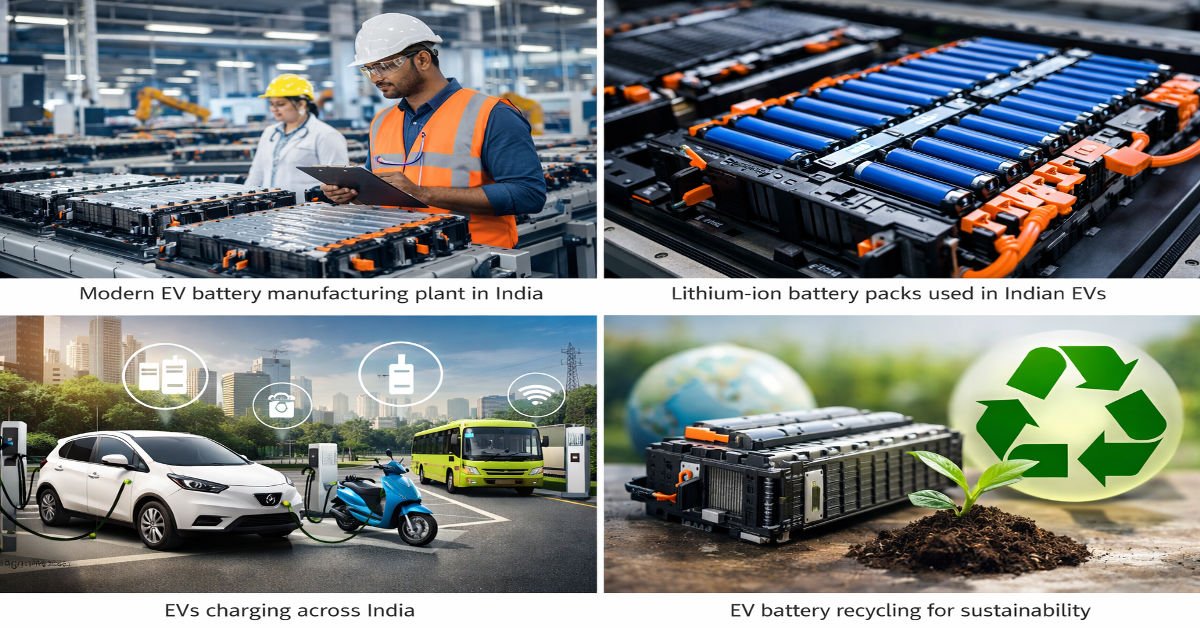
India’s electric vehicle (EV) revolution is no longer a future promise—it is already happening. With rising fuel costs, growing environmental awareness, and strong government support, electric vehicles are becoming a practical choice for Indian consumers. At the heart of this transformation lies one crucial component: the EV battery. EV battery makers in India play a vital role in shaping the performance, cost, safety, and sustainability of electric vehicles.
This article provides an in-depth, experience-based and trustworthy overview of EV battery manufacturers in India. It explains who the key players are, what technologies they use, how the Indian battery ecosystem is evolving, and why domestic battery manufacturing is essential for India’s clean mobility goals.
Why EV Batteries Are So Important in India
EV batteries are the most expensive and technologically complex part of an electric vehicle. In many cases, the battery alone accounts for 35–45% of the total EV cost. The quality of the battery directly affects driving range, charging time, safety, vehicle lifespan, and overall user experience.
For India, building a strong EV battery manufacturing ecosystem is critical because it helps reduce import dependency, lowers vehicle prices, creates jobs, and strengthens energy security. As EV adoption grows across two-wheelers, three-wheelers, cars, buses, and commercial fleets, demand for locally made batteries is rising rapidly.
Types of EV Batteries Used in India
Before understanding the manufacturers, it is important to know the main battery chemistries used in Indian electric vehicles.
| Battery Type | Key Features | Common Usage in India |
|---|---|---|
| Lithium-ion (Li-ion) | High energy density, fast charging, long life | EV cars, scooters, buses |
| LFP (Lithium Iron Phosphate) | Safer, longer cycle life, lower cost | Electric scooters, buses |
| NMC (Nickel Manganese Cobalt) | High performance, higher range | Premium EV cars |
| Lead-acid | Low cost, heavy, short life | E-rickshaws, low-speed EVs |
| Sodium-ion (emerging) | Lower cost, no lithium dependency | Under development |
Most modern EV battery makers in India focus on lithium-ion technologies, especially LFP and NMC, due to their balance of safety, cost, and performance.
Growth of EV Battery Manufacturing in India
India’s EV battery industry has grown significantly over the last few years. Earlier, most battery cells were imported from countries like China, South Korea, and Japan. Today, Indian companies are investing heavily in local assembly, cell manufacturing, and recycling.
Government initiatives such as the Production Linked Incentive (PLI) scheme for Advanced Chemistry Cell (ACC) manufacturing have encouraged both Indian and global players to set up gigafactories in India. This shift is helping India move from battery assembly to full-scale battery cell production.
Leading EV Battery Makers in India
Several Indian companies have emerged as key players in EV battery manufacturing. These companies supply batteries for two-wheelers, cars, buses, and energy storage systems.
Exide Industries
Exide Industries is one of India’s oldest and most trusted battery brands. Traditionally known for lead-acid batteries, Exide has made a strong entry into lithium-ion battery manufacturing for electric vehicles.
The company has invested in lithium-ion cell manufacturing and battery pack assembly through joint ventures and technology partnerships. Exide supplies EV batteries to electric car manufacturers, bus OEMs, and energy storage projects.
| Detail | Information |
|---|---|
| Founded | 1947 |
| Battery Focus | Lithium-ion, Lead-acid |
| EV Segments | Cars, buses, energy storage |
| Strength | Brand trust, wide distribution |
Amara Raja Energy & Mobility
Amara Raja is another major Indian battery manufacturer transitioning from conventional batteries to advanced EV battery solutions. The company has announced large investments in lithium-ion cell manufacturing and battery pack development.
Amara Raja focuses on building a complete battery ecosystem, including research, manufacturing, recycling, and energy storage. Its EV batteries are designed for Indian climate conditions, which improves safety and durability.
| Detail | Information |
|---|---|
| Founded | 1985 |
| Battery Focus | Lithium-ion, advanced chemistry |
| EV Segments | Two-wheelers, cars, grid storage |
| Strength | Strong R&D and infrastructure |
Tata Group (Tata AutoComp, Tata Chemicals)
The Tata Group plays a major role in India’s EV ecosystem. Through companies like Tata AutoComp and Tata Chemicals, the group is involved in battery pack manufacturing, raw materials, and future cell production.
Tata AutoComp supplies battery packs for Tata Motors’ electric vehicles, while Tata Chemicals is investing in lithium-ion cell manufacturing and battery materials. This integrated approach strengthens India’s domestic battery supply chain.
| Detail | Information |
|---|---|
| Group Presence | Automotive, chemicals, energy |
| Battery Focus | Lithium-ion cells and packs |
| EV Segments | Passenger cars, commercial EVs |
| Strength | End-to-end ecosystem |
Ola Electric (Ola Cell Manufacturing)
Ola Electric is not just an EV manufacturer but also a major EV battery maker in India. The company is building a large lithium-ion cell manufacturing facility as part of its future plans.
By manufacturing its own battery cells, Ola aims to reduce costs, improve performance, and control quality. This move is expected to make electric scooters more affordable for Indian consumers.
| Detail | Information |
|---|---|
| Founded | 2017 |
| Battery Focus | Lithium-ion cells |
| EV Segments | Electric scooters |
| Strength | Vertical integration |
Reliance New Energy
Reliance Industries has entered the EV battery space through Reliance New Energy Solar. The company is investing in advanced battery technologies, including lithium-ion and alternative chemistries.
Reliance’s long-term vision includes large-scale battery manufacturing, energy storage solutions, and renewable energy integration. Its entry has boosted confidence in India’s EV battery sector.
| Detail | Information |
|---|---|
| Parent Company | Reliance Industries |
| Battery Focus | Advanced chemistry, storage |
| EV Segments | EVs, grid storage |
| Strength | Financial strength, scale |
Ather Energy (Battery Packs)
Ather Energy designs and manufactures its own battery packs for electric scooters. While it currently sources cells from global suppliers, Ather’s battery management systems and thermal design are developed in-house.
This approach ensures better safety, performance, and reliability, making Ather a respected name among EV battery solution providers in India.
| Detail | Information |
|---|---|
| Founded | 2013 |
| Battery Focus | Lithium-ion battery packs |
| EV Segments | Electric scooters |
| Strength | Safety-focused design |
Emerging and Startup EV Battery Manufacturers
Apart from large companies, several Indian startups are innovating in battery technology, recycling, and alternative chemistries.
Log9 Materials
Log9 Materials focuses on fast-charging battery technologies and advanced battery materials. The company develops batteries suitable for Indian operating conditions and aims to reduce charging times significantly.
Altigreen Propulsion Labs
Altigreen designs battery systems specifically for electric three-wheelers and commercial EVs, where durability and cost efficiency are critical.
Lohum
Lohum specializes in battery recycling and second-life battery solutions. Recycling is essential for sustainable EV growth, and Lohum plays a key role in reducing environmental impact.
Role of Battery Recycling in India
As EV adoption increases, battery recycling becomes extremely important. EV batteries contain valuable materials like lithium, nickel, cobalt, and copper. Recycling helps recover these materials and reduces dependence on imports.
Indian battery makers are increasingly investing in recycling technologies to support a circular economy. This approach improves sustainability and aligns with India’s long-term clean energy goals.
| Benefit of Recycling | Impact |
|---|---|
| Resource recovery | Reduces raw material imports |
| Environmental safety | Prevents pollution |
| Cost reduction | Lowers battery prices |
| Sustainability | Supports circular economy |
Challenges Faced by EV Battery Makers in India
Despite rapid progress, EV battery manufacturers in India face several challenges.
High raw material costs remain a major concern, as lithium and cobalt are mostly imported. Technology development requires heavy investment, and scaling up cell manufacturing is complex. Safety standards, thermal management, and recycling infrastructure also need continuous improvement.
However, with policy support and growing demand, these challenges are gradually being addressed.
Government Support for EV Battery Manufacturing
The Indian government actively supports EV battery makers through incentives and policies.
Key initiatives include the PLI scheme for advanced battery manufacturing, FAME incentives for EV adoption, and relaxed norms for foreign investment and technology transfer. These measures encourage domestic production and global partnerships.
Future of EV Battery Makers in India
The future of EV battery manufacturing in India looks promising. With increasing EV sales, declining battery costs, and improvements in technology, India is expected to become a major global hub for EV batteries.
Emerging technologies like sodium-ion batteries, solid-state batteries, and improved recycling methods could further transform the industry. Indian battery makers are gradually moving from assembly to innovation-driven manufacturing.
Conclusion
EV battery makers in India are the backbone of the country’s electric mobility transition. From established companies like Exide and Amara Raja to innovative players like Ola Electric and emerging startups, the ecosystem is growing rapidly.
With strong government support, increasing consumer demand, and continuous technological advancement, India is well on its way to building a self-reliant and sustainable EV battery industry. As this sector matures, it will not only power electric vehicles but also contribute significantly to economic growth, job creation, and environmental protection.
3 thoughts on “EV Battery Makers in India: Companies Powering the Country’s Electric Mobility Future”