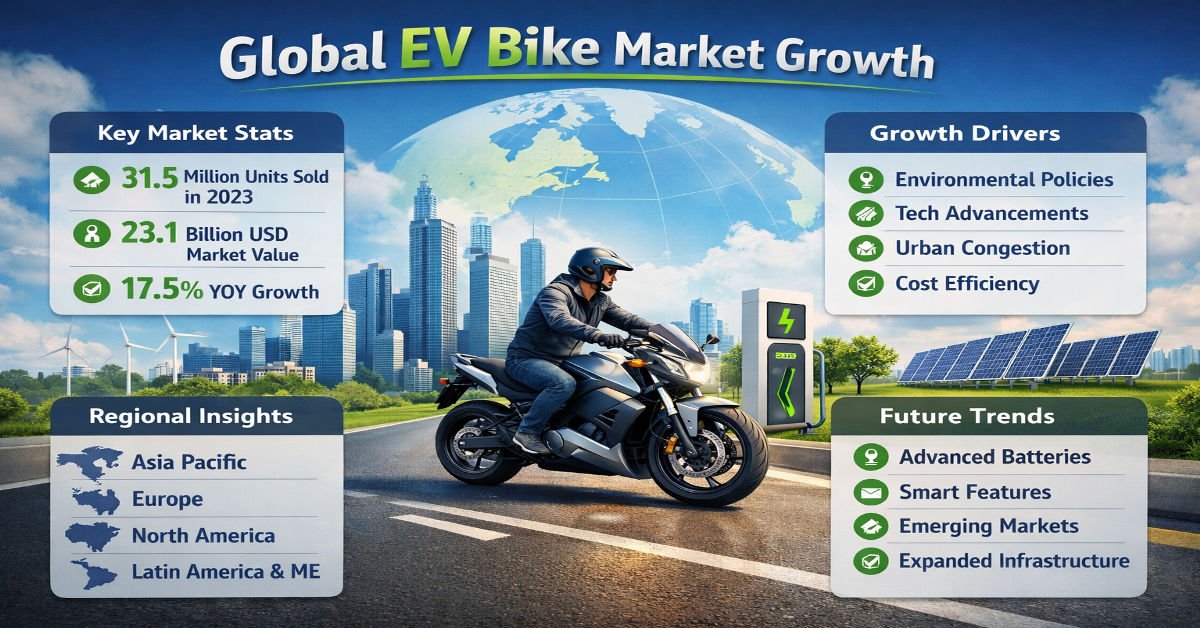
Global EV Bike Market Growth Electric vehicles have transformed modern transportation, and electric bikes (EV bikes) are leading this change in two-wheeler markets worldwide. As sustainability becomes a priority for governments, businesses, and consumers, the global EV bike market is growing rapidly. This article explores the key trends, drivers, challenges, and future forecasts shaping the global electric bike industry. With expert insights and real data, we aim to deliver a comprehensive and trustworthy analysis for readers, professionals, and market followers.
What Are EV Bikes?
Electric bikes, commonly known as e-bikes, are bicycles or motorcycles that use an electric motor for propulsion. They are powered by rechargeable batteries and are designed to enhance mobility, reduce carbon emissions, and provide cost-effective transportation options. EV bikes can vary from pedal-assist bicycles to fully battery-driven motorbikes capable of high speed and long range.
Why EV Bikes Matter Today
The world faces critical environmental and mobility challenges. Urban congestion, rising fuel costs, and climate change are pressuring governments and consumers to adopt eco-friendly transportation alternatives. EV bikes are positioned as one of the most scalable solutions due to their:
-
Low operating costs
-
Reduced emissions
-
Ease of use in cities
-
Growing infrastructure for charging
A Broad Overview of the Market
According to industry reports, the global EV bike market is expanding at an impressive pace. This growth is fueled by technological improvements, supportive regulations, and shifting consumer behavior toward green mobility. Below is a snapshot of key market figures.
Global EV Bike Market: Key Figures
| Year | Global EV Bike Sales (Million Units) | Market Value (USD Billion) | YOY Growth (%) |
|---|---|---|---|
| 2020 | 18.5 | 12.4 | – |
| 2021 | 22.3 | 14.8 | 20.5% |
| 2022 | 26.8 | 18.2 | 20.2% |
| 2023 | 31.5 | 23.1 | 17.5% |
| 2024* | 37.2 | 29.8 | 18.1% |
| 2025* | 44.7 | 38.4 | 20.2% |
*Projected values
This table highlights a strong upward trend in both unit sales and market value. The consistent double-digit growth indicates long-term demand and market resilience.
Drivers of Growth in the EV Bike Market
Strong Environmental Policy Support
Governments worldwide are actively promoting electric mobility as part of their climate commitments. Through subsidies, tax rebates, and stringent emission standards, electric bikes have become more affordable and attractive. For example, several countries have introduced incentives that lower purchase costs significantly, making EV bikes compete effectively with traditional fuel-powered two-wheelers.
Technological Advancements
Battery technologies such as lithium-ion and solid-state batteries have improved energy density, reduced costs, and enhanced safety. Better battery performance directly impacts the range and speed of EV bikes, increasing their practicality for everyday use.
Motor efficiency and lightweight materials also contribute to improved performance. The integration of smart features like regenerative braking, connectivity, and app-based controls adds appeal for tech-savvy consumers.
Urbanization and Congestion Challenges
Rapid urbanization has congested many cities. Traffic delays and limited parking space make EV bikes an efficient alternative for commuting. Their compact design and agility in crowded streets help riders save time and reduce travel stress.
Cost-Effectiveness and Affordability
Unlike traditional bikes that rely on fossil fuels, EV bikes incur lower running costs. Electricity is cheaper than petrol, and maintenance requirements are typically lower due to fewer mechanical components. This cost advantage attracts budget-conscious consumers seeking savings.
Changing Consumer Preferences
Younger generations are more environmentally conscious and willing to adopt technologies that align with their values. As public perception shifts toward sustainability, EV bikes become symbols of modern and responsible living.
Regional Insights
The growth trajectory varies across regions due to economic factors, infrastructure readiness, and government policies. Below is a regional breakdown of the EV bike market.
Asia Pacific
Asia Pacific dominates the EV bike market, primarily driven by high demand in countries such as China, India, and Southeast Asian nations. China is the world’s largest producer and consumer of electric bikes, supported by a vast manufacturing ecosystem and strong domestic demand. India’s fast-growing urban population and government initiatives like FAME (Faster Adoption and Manufacturing of Electric Vehicles) have also contributed significantly to market growth.
Europe
European countries emphasize sustainability and low-emission zones in urban centers. Nations like Germany, France, and the Netherlands have robust cycling cultures and supportive policies, making EV bikes popular for commuting and leisure.
North America
In North America, the adoption of EV bikes is growing as city planners and state governments invest in cycling infrastructure. Urban commuters are increasingly choosing e-bikes due to convenience and environmental awareness.
Latin America & Middle East
These regions are witnessing gradual adoption, driven by increased consumer interest in affordable and flexible transportation. Infrastructure development and market education remain key focus areas for further growth.
Market Segmentation
The global EV bike market can be segmented based on type, battery capacity, motor power, range, and end user. These segments help manufacturers tailor products to specific consumer needs and unlock niche opportunities.
By Type
| Type | Description | Examples |
|---|---|---|
| Pedal-Assist EV Bikes | Combines traditional pedaling with motor assistance | City bikes, hybrid e-bikes |
| Throttle-Driven EV Bikes | Full electric motor drive | Electric mopeds, scooters |
| High-Performance EV Bikes | Designed for higher speed and range | Electric motorcycles |
By Battery Capacity
Battery capacity determines the range and performance of an EV bike. Common categories include:
-
Below 1.5 kWh
-
1.5–3.0 kWh
-
Above 3.0 kWh
Higher battery capacity usually means more extended range and higher costs, appealing to long-distance commuters.
By Range
Range is one of the most critical factors influencing purchase decisions.
| Range Category | Typical Use Case |
|---|---|
| Below 50 km | Short city rides |
| 50–100 km | Daily commuting |
| Above 100 km | Long distance travel |
Key Players in the Global EV Bike Market
The competitive landscape includes traditional two-wheeler manufacturers transitioning toward electrification and startups focusing solely on electric mobility.
| Company | Headquarters | Known For |
|---|---|---|
| Hero Electric | India | Affordable e-bikes |
| Yadea Group | China | High-volume production |
| Ather Energy | India | Smart e-scooters |
| NIU Technologies | China | Connected e-bikes |
| Zero Motorcycles | USA | High-performance electric motorcycles |
These companies invest heavily in R&D to maintain competitive edge and meet evolving consumer demands.
Consumer Behavior and Adoption Trends
Understanding consumer behavior is central to analyzing EV bike adoption. Market research identifies several key preferences:
Prioritization of Range and Battery Life
Consumers often choose EV bikes with higher range and faster charging capabilities. Concerns about battery degradation remain a topic of interest for buyers.
Demand for Smart Features
Smart connectivity, GPS navigation, remote diagnostics, and mobile app integration are increasingly influencing purchase decisions, particularly among urban and young riders.
Price Sensitivity
Affordability remains a major factor, especially in emerging markets. Many buyers weigh upfront costs against long-term savings on fuel and maintenance.
Safety and Reliability
Safety features like advanced braking systems, sturdy build quality, and after-sales support contribute significantly to consumer trust and brand preference.
Infrastructure and Charging Ecosystem
A strong charging infrastructure boosts consumer confidence in EV mobility. Key components include:
-
Public charging stations
-
Home charging units
-
Battery swapping systems
Cities in Europe and Asia Pacific are developing more charging points, supporting long-distance travel and daily use.
Policy and Regulation Impact
Government policies have a direct impact on market dynamics. Examples include:
-
Purchase incentives and tax exemptions
-
Subsidies for manufacturers
-
Emission reduction mandates
-
Urban low-emission zones
Such policies make EV bikes more accessible and align national transportation goals with global sustainability targets.
Challenges Facing the Market
Despite rapid growth, the EV bike market faces several challenges:
Battery Cost and Resource Constraints
Battery manufacturing relies on materials like lithium, cobalt, and nickel. Price fluctuations and supply concerns can affect production costs and final pricing.
Charging Infrastructure Limitations
In many regions, especially rural areas, charging infrastructure remains underdeveloped. This limitation affects long-distance travel confidence.
Consumer Awareness and Education
Some consumers lack detailed information about EV bikes, particularly concerning total cost of ownership and battery health. Educating buyers is essential for broader adoption.
Standardization Issues
Different manufacturers use varied battery formats and charging standards. Lack of interoperability creates challenges for infrastructure development and consumer convenience.
Conclusion
The global EV bike market is experiencing remarkable growth driven by environmental policies, technological innovation, and changing consumer behavior. As urbanization accelerates and sustainability gains priority, electric bikes are poised to become a core component of future transportation systems.
From policy support to battery improvements, the industry’s next decade will likely witness deeper adoption, more competitive products, and broader infrastructure development. For consumers and businesses looking to invest in electric mobility, the future of EV bikes offers both opportunity and transformation.
I always look forward to reading your posts, they never fail to brighten my day and educate me in some way Thank you!
Квартиры в новостройках https://novye-kvartiry78.ru Кировского района Санкт-Петербурга для комфортной жизни и выгодных инвестиций. Актуальные предложения от застройщиков, студии, одно-, двух- и трехкомнатные квартиры, современные жилые комплексы, удобный поиск по цене, площади и срокам сдачи.
Ритуальные услуги http://www.buro-pohoron-vechnaya-pamyat.ru под ключ в Москве и Московской области. Поможем быстро и деликатно организовать похороны, подготовить необходимые документы, подобрать ритуальные принадлежности, транспорт и место захоронения. Круглосуточная консультация и сопровождение опытных специалистов.
Комплексное лечение https://medprime-clinic.ru/ и диагностика заболеваний с использованием современных медицинских методов. Полное обследование организма, точная постановка диагноза, индивидуальный план терапии, консультации специалистов и эффективное лечение с учетом особенностей здоровья пациента.
где взять займ быстрый займ